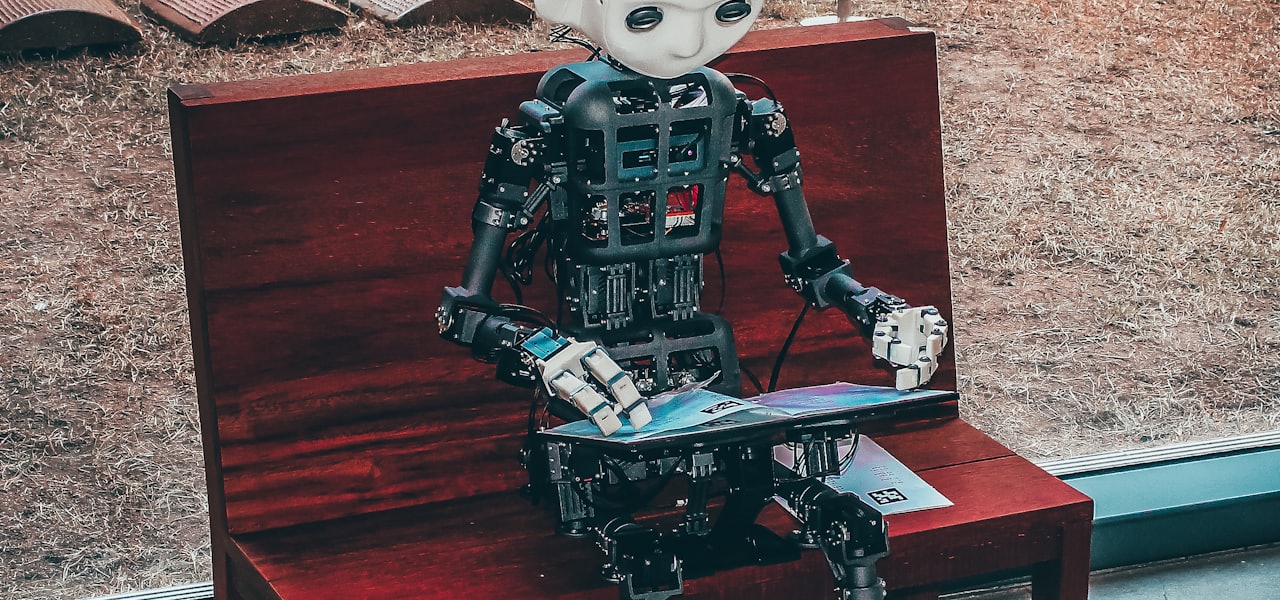
Automate This: How Algorithms Came to Rule Our World is a book written by Christopher Steiner and published by Penguin Group. == Book == Steiner begins his study of algorithms on Wall Street in the 1980s but also provides examples from other industries. For example, he explains the history of Pandora Radio and the use of algorithms in music identification. He expresses concern that such use of algorithms may lead to the homogenization of music over time. Steiner also discusses the algorithms that eLoyalty (now owned by Mattersight Corporation following divestiture of the technology) was created by dissecting 2 million speech patterns and can now identify a caller's personality style and direct the caller with a compatible customer support representative. Steiner's book shares both the warning and the opportunity that algorithms bring to just about every industry in the world, and the pros and cons of the societal impact of automation (e.g. impact on employment).
Rabbit r1
The Rabbit r1 is an artificial intelligence personal assistant device developed by the American technology startup Rabbit Inc and co-designed by Teenage Engineering. It was announced at the 2024 Consumer Electronics Show as a handheld device intended to perform digital tasks through voice commands, touch interaction, and web-based AI agents. The r1 was marketed around Rabbit's concept of a "large action model" (LAM), which the company described as software able to operate websites and services on behalf of users. The device runs rabbitOS, an operating system based on the Android Open Source Project. Its services have included AI search, image recognition, voice interaction, music playback, rideshare and food-ordering integrations, and later experimental web-agent features such as LAM Playground and teach mode. Initial reviews were largely negative, with reviewers criticizing the device's limited functionality, bugs, and unclear advantages over a smartphone. Critics also questioned Rabbit's claims after the r1 software was shown to run on an Android phone. Rabbit continued to issue software updates after launch, including rabbitOS 2 in September 2025, which introduced a redesigned card-based interface, gesture navigation, and a "creations" feature for generating small software tools and experiences on the device. Rabbit Inc was founded by Jesse Lyu Cheng. == Hardware == Display: A 2.88-inch touchscreen for interactive user input. Input: push-to-talk button to activate voice commands; scroll wheel; Gyroscope; Magnetometer; Accelerometer; GPS. Camera: 8 MP single camera, with a resolution of 3264x2448, allowing for the connected external AI to use computer vision. Audio: Equipped with a speaker and dual microphones for audio interaction. Connectivity: Supports Wi-Fi and cellular connections via a SIM card slot to access internet services. Processor: Runs on a 2.3GHz MediaTek Helio P35 processor. Memory: Contains 4GB of RAM for operational tasks. Storage: Offers 128GB of internal storage for data. Ports: Utilizes a USB-C port for charging and data connections. == Software == The Rabbit r1 runs rabbitOS, which is based on the Android Open Source Project (AOSP), specifically Android 13. Rabbit founder Jesse Lyu described rabbitOS as a "very bespoke AOSP" after reports that the r1's software could be run on a conventional Android phone. Rabbit described the r1 as using a large action model (LAM), a type of AI agent intended to perform tasks across software interfaces rather than only answer questions. At launch, the device supported a limited set of services, including AI search, vision features, music playback, and some third-party integrations. Perplexity.ai was one of the AI services used to answer user queries. In 2024, Rabbit released several software updates that added features and attempted to address early criticism of the device. In July 2024, the company launched "beta rabbit", an advanced search and conversation mode for more complex queries. In October 2024, it released LAM Playground, a web-based agent feature intended to let the r1 operate websites on behalf of users. Reviewers found the feature experimental; Android Authority reported that it could perform some navigation tasks but struggled with CAPTCHAs, loops, and unintended behavior. In November 2024, Rabbit introduced a beta "teach mode", which allowed users to demonstrate web-based tasks in the Rabbithole web portal and later ask the r1 to repeat them. The company described teach mode as experimental, and The Verge noted that Rabbit warned users that results could be unpredictable and that CAPTCHA-protected sites could cause problems. Rabbit released rabbitOS 2 in September 2025. The update redesigned the interface around a card-based layout, added additional touchscreen gestures, and introduced "creations", a feature that lets users generate simple software tools, games, and interfaces through natural-language prompts. Coverage of the update described it as a major software overhaul rather than new hardware. == Reception == === Funding === Rabbit raised $20 million in funding from Khosla Ventures, Synergis Capital and Kakao Investment in October 2023. The company announced an additional $10 million in funding in December 2023. === Sales === Following its announcement at the 2024 Consumer Electronics Show, 130,000 units were sold. On August 13, 2024, Rabbit announced that sales of r1 had expanded to the entire European Union (except Malta) and United Kingdom. On August 21, 2024, sales of r1 expanded to Singapore. === Reviews === The r1 was met with strong criticism immediately after Rabbit began shipping the device. Some reviews questioned what the device was able to do that a smartphone could not, while comparing it to the similar Humane Ai Pin. YouTuber Marques Brownlee called the device "barely reviewable". Android Authority's Mishaal Rahman managed to install Rabbit r1's software on a Pixel 6a smartphone, after a tipster shared an APK file. The Verge echoed the claims made by Rahman. In response, Lyu published statements confirming its use of Android, but denying that the r1 is an Android app. Mashable called its Vision features impressive, but said that "these praise-worthy features are overshadowed by buggy performance". Ars Technica wrote a blog post claiming "the company is blocking access from bootleg APKs". TechCrunch gave a slightly more positive review, calling the device a "fun peep at a possible future", but could not "advise anyone to buy one now." Shortly after the launch of r1, Rabbit began a weekly cadence of software updates to address much of the criticism from the early reviews, including "battery and GPS performance, time zone selection, and more". Digital Trends said the Magic Camera feature "takes the most mundane, ordinary, and badly composed photos and makes something fun and eye-catching from them." Mashable said the "beta rabbit" feature "makes Rabbit R1 more conversational and intelligent". Later coverage noted that Rabbit continued to update the r1 after its poorly received launch. The Verge reported in September 2024 that about 5,000 of roughly 100,000 purchasers were using the device at any given moment, citing Lyu, and described the product as having launched before it was ready. In 2025, coverage of rabbitOS 2 described the update as an attempt to reset the device's software experience after the criticism of its original release. == Controversies == === GAMA project === Rabbit Inc has garnered attention due to allegations surrounding its funding and the company's past projects. The company came under scrutiny when Stephen Findeisen, known as Coffeezilla on YouTube, published a video in May 2024, alleging that Rabbit Incorporation was "built on a scam". Rabbit Incorporation, initially named Cyber Manufacturing Co, rebranded just two months before launching the Rabbit R1. The company, under its former name, raised $6 million in November 2021 for a project called GAMA, described as a "Next Generation NFT Project." Jesse Lyu, the CEO of Rabbit Incorporation, referred to GAMA as a "fun little project." Coffeezilla, who investigates influencer scams, highlighted old Clubhouse recordings of Jesse Lyu discussing the GAMA project. In these recordings, Lyu emphasized the substantial funding behind GAMA and its potential to be a revolutionary, carbon-negative cryptocurrency. Coffeezilla questioned the whereabouts of the funds raised for GAMA, estimating that approximately $1 million in refunds to investors remained unresolved. He suggested that the rebranding to Rabbit Incorporation and the shift to developing the Rabbit R1 were attempts to divert from the GAMA project's issues. In response to Coffeezilla's inquiries, Rabbit Incorporation stated that the $6 million raised was used for the GAMA project. The company said that NFTs cannot be refunded unless the owner agrees to "burn" them on the blockchain. Rabbit Incorporation also said that the GAMA project was open-sourced and returned to the community, aligning with community feedback. They also mentioned that efforts to buy back NFTs were made to counteract malicious trading and maintain market stability. === Security === In June 2024, Engadget reported that the Rabbitude team, a community reverse engineering project, had gained access to the r1's codebase revealing that r1's software contained several hardcoded API keys in its code for ElevenLabs, Microsoft Azure, Yelp, and Google Maps, potentially allowing unauthorized access to r1 responses, including those containing the users' personal information. For a short time, Rabbit immediately began revoking and rotating those secrets and confirmed that the code was leaked by an employee who had "been terminated and remains under investigation". In July 2024, the company revealed that all user chats and device pairing data were logged on the r1 with no ability to delete them. This meant that lost or stolen devices could be used to extract user
Empowerment (artificial intelligence)
Empowerment in the field of artificial intelligence formalises and quantifies (via information theory) the potential an agent perceives that it has to influence its environment. An agent which follows an empowerment maximising policy, acts to maximise future options (typically up to some limited horizon). Empowerment can be used as a (pseudo) utility function that depends only on information gathered from the local environment to guide action, rather than seeking an externally imposed goal, thus is a form of intrinsic motivation. The empowerment formalism depends on a probabilistic model commonly used in artificial intelligence. An autonomous agent operates in the world by taking in sensory information and acting to change its state, or that of the environment, in a cycle of perceiving and acting known as the perception-action loop. Agent state and actions are modelled by random variables ( S : s ∈ S , A : a ∈ A {\displaystyle S:s\in {\mathcal {S}},A:a\in {\mathcal {A}}} ) and time ( t {\displaystyle t} ). The choice of action depends on the current state, and the future state depends on the choice of action, thus the perception-action loop unrolled in time forms a causal bayesian network. == Definition == Empowerment ( E {\displaystyle {\mathfrak {E}}} ) is defined as the channel capacity ( C {\displaystyle C} ) of the actuation channel of the agent, and is formalised as the maximal possible information flow between the actions of the agent and the effect of those actions some time later. Empowerment can be thought of as the future potential of the agent to affect its environment, as measured by its sensors. E := C ( A t ⟶ S t + 1 ) ≡ max p ( a t ) I ( A t ; S t + 1 ) {\displaystyle {\mathfrak {E}}:=C(A_{t}\longrightarrow S_{t+1})\equiv \max _{p(a_{t})}I(A_{t};S_{t+1})} In a discrete time model, Empowerment can be computed for a given number of cycles into the future, which is referred to in the literature as 'n-step' empowerment. E ( A t n ⟶ S t + n ) = max p ( a t , . . . , a t + n − 1 ) I ( A t , . . . , A t + n − 1 ; S t + n ) {\displaystyle {\mathfrak {E}}(A_{t}^{n}\longrightarrow S_{t+n})=\max _{p(a_{t},...,a_{t+n-1})}I(A_{t},...,A_{t+n-1};S_{t+n})} The unit of empowerment depends on the logarithm base. Base 2 is commonly used in which case the unit is bits. === Contextual Empowerment === In general the choice of action (action distribution) that maximises empowerment varies from state to state. Knowing the empowerment of an agent in a specific state is useful, for example to construct an empowerment maximising policy. State-specific empowerment can be found using the more general formalism for 'contextual empowerment'. C {\displaystyle C} is a random variable describing the context (e.g. state). E ( A t n ⟶ S t + n ∣ C ) = ∑ c ∈ C p ( c ) E ( A t n ⟶ S t + n ∣ C = c ) {\displaystyle {\mathfrak {E}}(A_{t}^{n}\longrightarrow S_{t+n}{\mid }C)=\sum _{c{\in }C}p(c){\mathfrak {E}}(A_{t}^{n}\longrightarrow S_{t+n}{\mid }C=c)} == Application == Empowerment maximisation can be used as a pseudo-utility function to enable agents to exhibit intelligent behaviour without requiring the definition of external goals, for example balancing a pole in a cart-pole balancing scenario where no indication of the task is provided to the agent. Empowerment has been applied in studies of collective behaviour and in continuous domains. As is the case with Bayesian methods in general, computation of empowerment becomes computationally expensive as the number of actions and time horizon extends, but approaches to improve efficiency have led to usage in real-time control. Empowerment has been used for intrinsically motivated reinforcement learning agents playing video games, and in the control of underwater vehicles.
AI Security Institute
The AI Security Institute (AISI) is a research organisation under the Department for Science, Innovation and Technology, UK, that aims "to equip governments with a scientific understanding of the risks posed by advanced AI". It conducts research and develop and test mitigations. Previously, it was known as the AI Safety Institute. Its creation followed world's first major AI Safety Summit that was held in Bletchley Park in 2023. The institute's professed goal is "building the world's leading understanding of advanced AI risks and solutions, to inform governments so they can keep the public safe". It is designed like a startup in the government "combining the authority of government with the expertise and agility of the private sector". AISI has made access agreements with Anthropic, Google and OpenAI to test their models before release. It has an open source platform called Inspect that permits companies, governments and academics to run standardised safety tests for AI usage. Among the works AISI has done is the reported detection of multiple serious vulnerabilities that could enable development of biological weapons; the vulnerabilities were fixed before the model was launched. It conducts research on diverse fields of AI application. One study by AISI found that LLMs post-trained for political persuasiveness became systematically less accurate and up to 51% more persuasive on political issues. AISI has also worked on the usage of AI for emotional needs. It found that nearly 10 percent of UK citizens used systems like chatbots for emotional purposes on a weekly basis. It found that "systems are now outperforming PhD-level researchers on scientific knowledge tests and helping non-experts succeed at lab work that would previously have been out of reach" in a report published in December 2025. Former chief AI officer of GCHQ Adam Beaumont is the institution's interim director. UK prime minister's AI advisor Jade Leung is the chief technology officer.
Mountain car problem
Mountain Car, a standard testing domain in Reinforcement learning, is a problem in which an under-powered car must drive up a steep hill. Since gravity is stronger than the car's engine, even at full throttle, the car cannot simply accelerate up the steep slope. The car is situated in a valley and must learn to leverage potential energy by driving up the opposite hill before the car is able to make it to the goal at the top of the rightmost hill. The domain has been used as a test bed in various reinforcement learning papers. == Introduction == The mountain car problem, although fairly simple, is commonly applied because it requires a reinforcement learning agent to learn on two continuous variables: position and velocity. For any given state (position and velocity) of the car, the agent is given the possibility of driving left, driving right, or not using the engine at all. In the standard version of the problem, the agent receives a negative reward at every time step when the goal is not reached; the agent has no information about the goal until an initial success. == History == The mountain car problem appeared first in Andrew Moore's PhD thesis (1990). It was later more strictly defined in Singh and Sutton's reinforcement learning paper with eligibility traces. The problem became more widely studied when Sutton and Barto added it to their book Reinforcement Learning: An Introduction (1998). Throughout the years many versions of the problem have been used, such as those which modify the reward function, termination condition, and the start state. == Techniques used to solve mountain car == Q-learning and similar techniques for mapping discrete states to discrete actions need to be extended to be able to deal with the continuous state space of the problem. Approaches often fall into one of two categories, state space discretization or function approximation. === Discretization === In this approach, two continuous state variables are pushed into discrete states by bucketing each continuous variable into multiple discrete states. This approach works with properly tuned parameters but a disadvantage is information gathered from one state is not used to evaluate another state. Tile coding can be used to improve discretization and involves continuous variables mapping into sets of buckets offset from one another. Each step of training has a wider impact on the value function approximation because when the offset grids are summed, the information is diffused. === Function approximation === Function approximation is another way to solve the mountain car. By choosing a set of basis functions beforehand, or by generating them as the car drives, the agent can approximate the value function at each state. Unlike the step-wise version of the value function created with discretization, function approximation can more cleanly estimate the true smooth function of the mountain car domain. === Eligibility traces === One aspect of the problem involves the delay of actual reward. The agent is not able to learn about the goal until a successful completion. Given a naive approach for each trial the car can only backup the reward of the goal slightly. This is a problem for naive discretization because each discrete state will only be backed up once, taking a larger number of episodes to learn the problem. This problem can be alleviated via the mechanism of eligibility traces, which will automatically backup the reward given to states before, dramatically increasing the speed of learning. Eligibility traces can be viewed as a bridge from temporal difference learning methods to Monte Carlo methods. == Technical details == The mountain car problem has undergone many iterations. This section focuses on the standard well-defined version from Sutton (2008). === State variables === Two-dimensional continuous state space. V e l o c i t y = ( − 0.07 , 0.07 ) {\displaystyle Velocity=(-0.07,0.07)} P o s i t i o n = ( − 1.2 , 0.6 ) {\displaystyle Position=(-1.2,0.6)} === Actions === One-dimensional discrete action space. m o t o r = ( l e f t , n e u t r a l , r i g h t ) {\displaystyle motor=(left,neutral,right)} === Reward === For every time step: r e w a r d = − 1 {\displaystyle reward=-1} === Update function === For every time step: A c t i o n = [ − 1 , 0 , 1 ] {\displaystyle Action=[-1,0,1]} V e l o c i t y = V e l o c i t y + ( A c t i o n ) ∗ 0.001 + cos ( 3 ∗ P o s i t i o n ) ∗ ( − 0.0025 ) {\displaystyle Velocity=Velocity+(Action)0.001+\cos(3Position)(-0.0025)} P o s i t i o n = P o s i t i o n + V e l o c i t y {\displaystyle Position=Position+Velocity} === Starting condition === Optionally, many implementations include randomness in both parameters to show better generalized learning. P o s i t i o n = − 0.5 {\displaystyle Position=-0.5} V e l o c i t y = 0.0 {\displaystyle Velocity=0.0} === Termination condition === End the simulation when: P o s i t i o n ≥ 0.6 {\displaystyle Position\geq 0.6} == Variations == There are many versions of the mountain car which deviate in different ways from the standard model. Variables that vary include but are not limited to changing the constants (gravity and steepness) of the problem so specific tuning for specific policies become irrelevant and altering the reward function to affect the agent's ability to learn in a different manner. An example is changing the reward to be equal to the distance from the goal, or changing the reward to zero everywhere and one at the goal. Additionally, a 3D mountain car can be used, with a 4D continuous state space.
Likewise, Inc.
Likewise, Inc., is an American technology startup company which provides a social networking service for finding and saving content recommendations for movies, TV shows, books, and podcasts. A team of ex-Microsoft employees founded Likewise in October 2017 with financial investment from Microsoft co-founder Bill Gates. The company is led by CEO Ian Morris and as of 2020 had a team of about 35 employees. Its headquarters operates in Bellevue, Washington. As of July 2020, 1 million users had joined the platform. == History == === Ideation (October 2017) === In 2017, former Microsoft Communications Chief Larry Cohen came up with the idea for Likewise in Bill Gates’ private office, Gates Ventures. Cohen currently serves as Gates Ventures’ CEO and managing partner. Cohen collaborated with colleagues Michael Dix and Ian Morris to co-found what would become Likewise, with Morris as its CEO. Gates funded the company's early development. The company developed its platform in stealth mode before launching publicly in October 2018. === Release (October 2018) === Likewise officially released its platform in the US and Canada on October 3, 2018. === Growth (2020 COVID-19 pandemic) === Likewise experienced accelerated growth alongside the COVID-19 pandemic. From March 2020 to July 2020, the platform's monthly active users tripled in numbers. The company reached one million users in July 2020. == Applications == === Mobile === Likewise is available as a mobile app for the Android and iOS mobile operating systems. Users receive recommendations from the Likewise algorithm, people they follow, and the Likewise editorial team. === Likewise TV === In October 2019, the company launched its Apple TV app called Likewise TV. The television app organizes shows across streaming services under one watchlist. On July 20, 2020, Likewise TV expanded to Android TV and Amazon Fire TV users.
Feature engineering
Feature engineering is a preprocessing step in supervised machine learning and statistical modeling which transforms raw data into a more effective set of inputs. Each input comprises several attributes, known as features. By providing models with relevant information, feature engineering significantly enhances their predictive accuracy and decision-making capability. Beyond machine learning, the principles of feature engineering are applied in various scientific fields, including physics. For example, physicists construct dimensionless numbers such as the Reynolds number in fluid dynamics, the Nusselt number in heat transfer, and the Archimedes number in sedimentation. They also develop first approximations of solutions, such as analytical solutions for the strength of materials in mechanics. == Clustering == One of the applications of feature engineering has been clustering of feature-objects or sample-objects in a dataset. Especially, feature engineering based on matrix decomposition has been extensively used for data clustering under non-negativity constraints on the feature coefficients. These include Non-Negative Matrix Factorization (NMF), Non-Negative Matrix-Tri Factorization (NMTF), Non-Negative Tensor Decomposition/Factorization (NTF/NTD), etc. The non-negativity constraints on coefficients of the feature vectors mined by the above-stated algorithms yields a part-based representation, and different factor matrices exhibit natural clustering properties. Several extensions of the above-stated feature engineering methods have been reported in literature, including orthogonality-constrained factorization for hard clustering, and manifold learning to overcome inherent issues with these algorithms. Other classes of feature engineering algorithms include leveraging a common hidden structure across multiple inter-related datasets to obtain a consensus (common) clustering scheme. An example is Multi-view Classification based on Consensus Matrix Decomposition (MCMD), which mines a common clustering scheme across multiple datasets. MCMD is designed to output two types of class labels (scale-variant and scale-invariant clustering), and: is computationally robust to missing information, can obtain shape- and scale-based outliers, and can handle high-dimensional data effectively. Coupled matrix and tensor decompositions are popular in multi-view feature engineering. == Predictive modelling == Feature engineering in machine learning and statistical modeling involves selecting, creating, transforming, and extracting data features. Key components include feature creation from existing data, transforming and imputing missing or invalid features, reducing data dimensionality through methods like Principal Components Analysis (PCA), Independent Component Analysis (ICA), and Linear Discriminant Analysis (LDA), and selecting the most relevant features for model training based on importance scores and correlation matrices. Features vary in significance. Even relatively insignificant features may contribute to a model. Feature selection can reduce the number of features to prevent a model from becoming too specific to the training data set (overfitting). Feature explosion occurs when the number of identified features is too large for effective model estimation or optimization. Common causes include: Feature templates - implementing feature templates instead of coding new features Feature combinations - combinations that cannot be represented by a linear system Feature explosion can be limited via techniques such as regularization, kernel methods, and feature selection. == Automation == Automation of feature engineering is a research topic that dates back to the 1990s. Machine learning software that incorporates automated feature engineering has been commercially available since 2016. Related academic literature can be roughly separated into two types: Multi-relational Decision Tree Learning (MRDTL) uses a supervised algorithm that is similar to a decision tree. Deep Feature Synthesis uses simpler methods. === Multi-relational Decision Tree Learning (MRDTL) === Multi-relational Decision Tree Learning (MRDTL) extends traditional decision tree methods to relational databases, handling complex data relationships across tables. It innovatively uses selection graphs as decision nodes, refined systematically until a specific termination criterion is reached. Most MRDTL studies base implementations on relational databases, which results in many redundant operations. These redundancies can be reduced by using techniques such as tuple id propagation. === Open-source implementations === There are a number of open-source libraries and tools that automate feature engineering on relational data and time series: featuretools is a Python library for transforming time series and relational data into feature matrices for machine learning. MCMD: An open-source feature engineering algorithm for joint clustering of multiple datasets. OneBM or One-Button Machine combines feature transformations and feature selection on relational data with feature selection techniques. OneBM helps data scientists reduce data exploration time allowing them to try and error many ideas in short time. On the other hand, it enables non-experts, who are not familiar with data science, to quickly extract value from their data with a little effort, time, and cost. getML community is an open source tool for automated feature engineering on time series and relational data. It is implemented in C/C++ with a Python interface. It has been shown to be at least 60 times faster than tsflex, tsfresh, tsfel, featuretools or kats. tsfresh is a Python library for feature extraction on time series data. It evaluates the quality of the features using hypothesis testing. tsflex is an open source Python library for extracting features from time series data. Despite being 100% written in Python, it has been shown to be faster and more memory efficient than tsfresh, seglearn or tsfel. seglearn is an extension for multivariate, sequential time series data to the scikit-learn Python library. tsfel is a Python package for feature extraction on time series data. kats is a Python toolkit for analyzing time series data. === Deep feature synthesis === The deep feature synthesis (DFS) algorithm beat 615 of 906 human teams in a competition. == Feature stores == The feature store is where the features are stored and organized for the explicit purpose of being used to either train models (by data scientists) or make predictions (by applications that have a trained model). It is a central location where you can either create or update groups of features created from multiple different data sources, or create and update new datasets from those feature groups for training models or for use in applications that do not want to compute the features but just retrieve them when it needs them to make predictions. A feature store includes the ability to store code used to generate features, apply the code to raw data, and serve those features to models upon request. Useful capabilities include feature versioning and policies governing the circumstances under which features can be used. Feature stores can be standalone software tools or built into machine learning platforms. == Alternatives == Feature engineering can be a time-consuming and error-prone process, as it requires domain expertise and often involves trial and error. Deep learning algorithms may be used to process a large raw dataset without having to resort to feature engineering. However, deep learning algorithms still require careful preprocessing and cleaning of the input data. In addition, choosing the right architecture, hyperparameters, and optimization algorithm for a deep neural network can be a challenging and iterative process.